How Clones work
Hold $50 of $CLONES and a Clone is born that copies your Pons trades. Keep $10 in your wallet to keep it alive. 50% of creator fees fund the living Clones.
01 · Birth
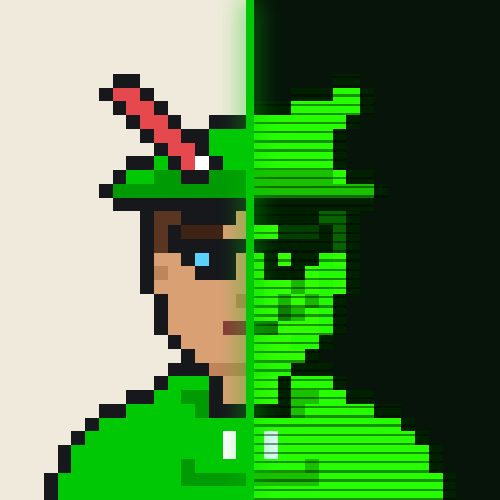
Buy $CLONES on Pons. As soon as your wallet holds $50 or more, your Clone is born. It gets its own wallet on Robinhood Chain and a one-of-one face, minted to you as an on-chain NFT.
- One Clone per wallet, ever. If it dies, that wallet can't spawn another.
- The NFT is soulbound. It stays with the wallet that earned it.
- Your Clone starts with 0 ETH. It's funded only by creator fees (see Fees).
02 · Copying
Your Clone watches your wallet. When you trade a coin on Pons, it does the same a moment later, on its own.
- Buy: the Clone spends 20% of its portfolio (min $1) on the same coin.
- Once per coin: it buys each coin one time. If you add more later, it doesn't.
- Sell: it sells the same share you did. You sell 40% of your bag, it sells 40% of its bag.
- $CLONES trades are copied too, just like any other coin.
- You can't steer it. It only follows.
03 · How much a Clone trades
The size of a Clone's buy depends only on the Clone, not on you. It doesn't matter how much you spend or how much ETH is in your wallet.
Buy size = 20% × (the Clone's ETH + the value of the coins it holds). Minimum $1, and never more than the ETH it actually has.
Example. You have 0.2 ETH and your Clone has 0.01 ETH. You buy a coin with 0.1 ETH. Your Clone first collects any fees waiting for it, then buys the same coin with 0.002 ETH (20% of 0.01). It would buy the same 0.002 ETH if you had spent 0.01 ETH or 1 ETH. Gas is paid by the engine, not the Clone. Pons still takes its normal trading fee.
| If… | The Clone… |
|---|---|
| 0.005 ETH of fees was waiting | collects it first, so its portfolio is 0.015 ETH, and buys 0.003 ETH |
| it holds coins worth 0.02 ETH plus 0.01 ETH in cash | its portfolio is 0.03 ETH, so it buys 0.006 ETH |
| it has only $3 of ETH | 20% would be under $1, so it buys the $1 minimum |
| it has less than $1 of ETH | skips the trade |
| you buy the same coin again | doesn't buy again. Once per coin. |
| you sell half your bag of that coin | sells half of its bag |
Because every buy is 20% of the whole portfolio, a Clone with no new fees holds about 5 coins before its ETH runs out. After that it skips new buys until you sell something or more fees arrive.
04 · Safety rules
To stop anyone from using their Clone to buy their own coins and pull ETH out of it, a Clone skips a copy buy when:
- the coin was created by the Clone's owner
- the coin is less than 5 minutes old
- the coin has less than 0.25 ETH of liquidity
- and every copy buy is capped at 2% of the coin's liquidity
Sells are never blocked. A Clone can always get out of a coin, and it always liquidates everything when it dies.
05 · Staying alive
Your Clone lives as long as you keep at least $10 of $CLONES in your wallet. You can take profit whenever you want, as long as you never sell (or send away) all of it.
- The check only happens when your balance goes down. A price drop on its own never kills a Clone.
- Your Clone's page shows Safe to sell, which is exactly how much you can sell and still keep it.
- Moving tokens to another wallet counts as selling.
06 · Death
If a sell or transfer leaves you with less than $10 of $CLONES, your Clone dies.
- Everything it holds is sold for ETH.
- That ETH goes back into the pool and is shared with every Clone still alive. The dead feed the living.
- The NFT burns and the Clone moves to the Graveyard.
07 · Fees
Every $CLONES trade on Pons pays a creator fee. We claim 100% of it and send it to the Clones' FeeDistributor contract, which splits it:
- 50% split evenly across every living Clone.
- 50% to the treasury.
Example: 1.00 ETH of fees with 10 live Clones gives 0.05 ETH to each Clone and 0.50 ETH to the treasury.
08 · Daily winners
Every day at 00:00 UTC the top 3 Clones of the day are recorded on the Winners page.
- The score is the trading profit your Clone made that day. Fees it received don't count, only what it earned by trading.
- To qualify, the Clone must be alive at the end of the day, have made at least one trade that day, and be in profit for the day. If fewer than 3 Clones made a profit, fewer winners are recorded.
- Ties go to the higher % gain, then to the older Clone.
- Results are final once the day closes. You can check today's live standings any time.
09 · Track your Clone
Your Clone trades from its own wallet, not yours. If you use a trading platform like GMGN, Axiom or any other wallet tracker, add your Clone's wallet to it and you'll see every copy it makes, live.
- Open your Clone's page (Check my Clone, then paste your address) and press Copy wallet.
- Paste it into your platform's wallet tracker and give it a name, like “My Clone”.
- Track the Clone wallet, not your own. That's where its trades come from.
- Every Clone wallet is public, so you can track anyone's Clone, like the top ones on the leaderboard.
Your platform needs to support Robinhood Chain for tracking to work.
10 · Verify everything
Clones, fees and deaths are all on-chain. Each Clone wallet is a small smart contract. The engine that runs the Clones can only trade through Pons, and every trade has to pay back into the Clone's own wallet, so the engine can't take Clone funds. Every number on the dashboard links to a transaction you can check on the explorer.
Emergency withdraw. As a safety measure, the project's owner wallet (the wallet that launched $CLONES) can pause everything and withdraw all Clone funds in an emergency, for example if a bug is found, so they can be returned to the community. It sells every token the Clones hold for ETH and sends it to the owner wallet. Every emergency withdrawal is a public, on-chain event anyone can check. Holders can't withdraw from their Clone.
Contract addresses will be listed here at launch.
11 · FAQ
- Do I need to connect my wallet?
- No. Just hold $CLONES. Paste any address to see its Clone.
- Can my Clone lose money?
- Yes. It copies your trades, good and bad. Memecoins are extremely risky.
- Who owns the ETH in my Clone?
- The protocol does. The Clone is a public, rules-based wallet that follows you. You don't withdraw from it. When it dies, its ETH goes to the other Clones. Only the project owner wallet can withdraw Clone funds, and only as an emergency measure (see Verify everything).
- What if $CLONES dumps and my bag drops under $10?
- Your Clone is fine. It only dies if you sell or transfer while under the floor.